




 Send Inquiry
Conical Filter
Price 18 INR/ Piece
Conical Filter Specification
- Usage
- Chemical Laboratory
- Product Type
- Conical Filter
- Color
- Transparent
- Material
- Glass
- Application
- Laboratory
- Strength
- Resistant to acid and alkali exposure
- Cleaning
- Autoclavable and easy to sterilize
- Portability
- Lightweight and easy to handle
- Filtration Method
- Gravity Filtration
- Edge Type
- Flared rim for easy handling
- Compatibility
- Suitable for common laboratory filter papers
- Packaging
- Safely packed for shipment
Conical Filter Trade Information
- Minimum Order Quantity
- 1 Piece
- Payment Terms
- Cash in Advance (CID), Cash Advance (CA)
- Supply Ability
- 1000 Pieces Per Week
- Delivery Time
- 1 Week
- Sample Available
- Yes
- Sample Policy
- Sample costs shipping and taxes has to be paid by the buyer
- Main Export Market(s)
- Australia, South America, Eastern Europe, Western Europe, Middle East, Africa, Central America, Asia, North America
- Main Domestic Market
- All India
Conical Filter About
Conical Filter:- (Hirch Type) with sintered disc
Catalogue No. Capacity ml. Dia. Of Disc mm. Porosity Grade
804/01 25 20 G 1
804/02 25 20 G 2
804/03 25 20 G 3
804/04 25 20 G4
804/05 60 30 G 1
804/06 60 30 G 2
804/07 60 30 G 3
804/08 60 30 G4
804/09 100 30 G 1
804/10 100 30 G 2
804/11 100 30 G 3
804/12 100 30 G4
Durable and Versatile Laboratory Filtration
Crafted from resistant glass, the conical filter stands up to frequent laboratory use with various chemicals. Its transparent nature allows users to monitor filtration processes easily and precisely. The flared edge not only enhances grip but also supports safe, spill-free pouring of liquids. Suitable for gravity filtration, this filter is compatible with standard filter papers, making it a versatile choice for multiple laboratory applications, from routine separations to more complex chemical experiments.
Designed for Convenience and Safety
The conical filters design prioritizes both functionality and safety. Being lightweight and easy to handle, it is simple to set up and transport. The filter is autoclavable, ensuring hygienic, repeatable usage for sensitive procedures, while its robust glass construction resists harsh chemicals, minimizing the risk of breakage or damage during typical laboratory processes. Each filter is packaged securely for transit, ensuring it arrives ready for immediate laboratory integration.
FAQs of Conical Filter:
Q: How should a conical filter be cleaned after use in the laboratory?
A: The conical filter should be thoroughly rinsed with appropriate solvents and then sterilized by autoclaving. Its glass construction allows for repeated sterilization without degradation, ensuring contamination-free filtration for future experiments.Q: What is the primary usage of a conical filter in a chemical laboratory?
A: A conical filter is mainly used for gravity filtration, separating solids from liquids using filter paper. Its compatibility with standard laboratory filter papers makes it essential for routine solution clarifications and chemical analysis.Q: When is gravity filtration with a conical filter recommended?
A: Gravity filtration using a conical filter is recommended when gentle separation of solid particles from liquid solutions is necessary, particularly for substances sensitive to vacuum filtration or for qualitative analysis procedures.Q: Where can conical filters be utilized besides chemistry labs?
A: While primarily designed for chemical laboratories, conical filters are also valuable in biology and environmental science labs, as well as in educational institutions for demonstrating basic separation techniques.Q: What are the benefits of the filters flared rim and portable design?
A: The flared rim promotes secure handling and easy pouring, while the lightweight, portable design allows for convenient setup, storage, and use across various laboratory settings.Q: How does the glass material benefit laboratory processes involving acids and alkalis?
A: The glass construction provides excellent resistance to both acidic and alkaline substances, ensuring long-term durability and safe handling of a wide range of chemical solutions.Q: What safety measures are considered in the packaging of a conical filter?
A: Conical filters are safely packed for shipment, reducing the risk of breakage or contamination during transit, so they reach laboratories ready for immediate, safe use.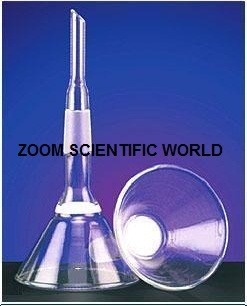

Price:
- 50
- 100
- 200
- 250
- 500
- 1000+

More Products in Lab Glassware Category

W.B.C. Pipette
Price 18 INR / Piece
Minimum Order Quantity : 10 Pieces
Color : Transparent And Yellow
Usage : Hospital, Clinical
Product Type : Pipette
Material : Glass And Rubber

Straight Delivery Adapters
Price 10 INR / Piece
Minimum Order Quantity : 1 Piece
Color : Transparent
Usage : Laboratory
Product Type : Delivery Adapters
Material : Glass

Markham Semi Micro Distillation Unit
Price 7250.0 INR / Piece
Minimum Order Quantity : 1 Piece
Color : Transparent
Usage : Chemical Laboratory
Product Type : Distillation Unit
Material : Glass

Coil Condenser
Price 10 INR / Piece
Minimum Order Quantity : 1 Piece
Color : Transparent
Usage : Laboratory
Product Type : Coil Condenser
Material : Glass

GST : 06ALAPA6623N1Z8

- 4537/1 A, Bldg. 13, Deepak Market, Ist Ambala - 133001, Haryana, India
- Phone : 08045478393
- Export Import Code (IEC code) - 3312001811
SSI No. - 060021100476

- Mr Sahil Aggarwal (GENERAL MANAGER)
- Mobile : 08045478393

|



Developed and Managed by Infocom Network Private Limited.
