




 Send Inquiry
Haemoglobinometer
Price 101 INR/ Unit
MOQ : 1 Unit
Haemoglobinometer Specification
- Usage
- Laboratory
- Material
- Plastic
- Product Type
- Haemoglobinometer
- Voltage
- 120 to 220 Volt (v)
- Color
- Black
- Packaging Type
- Boxed set
- Minimum Order Quantity
- 1 Unit
Haemoglobinometer Trade Information
- Minimum Order Quantity
- 1 Unit
- Payment Terms
- Cash in Advance (CID), Cash Advance (CA)
- Supply Ability
- 100 Units, Per Week
- Delivery Time
- 1 Week
- Sample Available
- Yes
- Sample Policy
- Sample costs shipping and taxes has to be paid by the buyer
- Main Export Market(s)
- Australia, North America, South America, Eastern Europe, Western Europe, Middle East, Central America, Asia, Africa
- Main Domestic Market
- All India
Haemoglobinometer About
Haemoglobinometer Sahil's:-
ZOOM offer the haemoglobinometer square tube type |
The kit consists of following standard setup: |
|
Reliable Haemoglobin Testing
The Haemoglobinometer employs Sahlis method, a proven approach for assessing haemoglobin concentration in blood. Built from robust plastic, it offers consistent performance in clinical, research, and educational settings. Laboratories appreciate its ease of use and accuracy for essential blood analyses.
Versatile Voltage Compatibility
Operating on 120 to 220 Volt input, this device ensures adaptability to standard laboratory electrical systems. Its universal voltage specification removes concerns about compatibility, making installation and operation seamless for users across India and abroad.
FAQs of Haemoglobinometer:
Q: How does the Haemoglobinometer determine haemoglobin concentration in blood samples?
A: The Haemoglobinometer uses Sahlis method, which involves mixing the blood sample with an acid reagent to convert haemoglobin to acid haematin. The intensity of the resulting color is compared with a standard to determine the haemoglobin concentration.Q: What is the main benefit of using a Haemoglobinometer in laboratory settings?
A: The Haemoglobinometer provides a quick and direct method for measuring haemoglobin, supporting timely diagnosis and research. Its simplicity and reliability make it an essential tool for routine blood analysis.Q: Where is the Haemoglobinometer typically used?
A: This instrument is commonly utilized in medical, educational, and research laboratories, as well as diagnostic centers throughout India. It is suitable for institutions requiring frequent haemoglobin estimations.Q: What voltage supply is required for operating the Haemoglobinometer?
A: The device operates on a voltage range of 120 to 220 Volts (v), making it compatible with most laboratory electrical outlets.Q: What is the process for using the Haemoglobinometer according to Sahlis method?
A: To use the Haemoglobinometer, a measured blood sample is mixed with a specific amount of acid reagent in the device. The color developed is compared visually or with a scale to estimate the haemoglobin concentration.Q: What material is the Haemoglobinometer made of, and why is it preferred?
A: It is constructed from plastic, which offers durability and resistance to corrosion, making it ideal for regular laboratory use.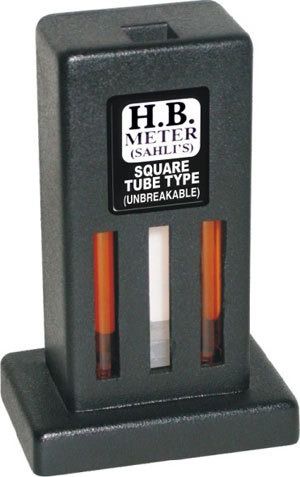
Tell us about your requirement

Price:
Quantity
Select Unit
- 50
- 100
- 200
- 250
- 500
- 1000+
Additional detail
Mobile number
Email

More Products in Scientific Product Category

Student Polarimeter
Price 143 INR / Unit
Minimum Order Quantity : 1 Unit
Color : Black And White
Product Type : Polarimeter
Material : Stainless Steel
Usage : Industrial

Histamine Chamber
Price 120 INR / Unit
Minimum Order Quantity : 1 Unit
Color : White
Product Type : Histamine Chamber
Material : Acrylic Sheet with Glass

Pestle And Mortar
Price 55 INR / Piece
Minimum Order Quantity : 1 Piece
Color : White
Product Type : Pestle
Material : Marble
Usage : Laboratory
X Ray View Box
Price 100 INR / Unit
Minimum Order Quantity : 1 Piece
Color : Black And White
Product Type : X Ray View Box
Usage : Clinical, Hospital

ZOOM SCIENTIFIC WORLD
GST : 06ALAPA6623N1Z8
GST : 06ALAPA6623N1Z8
Contact Details

- 4537/1 A, Bldg. 13, Deepak Market, Ist Ambala - 133001, Haryana, India
- Phone : 08045478393
- Export Import Code (IEC code) - 3312001811
SSI No. - 060021100476

- Mr Sahil Aggarwal (GENERAL MANAGER)
- Mobile : 08045478393

|



ZOOM SCIENTIFIC WORLD
All Rights Reserved.(Terms of Use)
Developed and Managed by Infocom Network Private Limited.
Developed and Managed by Infocom Network Private Limited.
