




 Send Inquiry
HUMAN PELVIS MALE
Price 107 INR/ Piece
HUMAN PELVIS MALE Specification
- Product Type
- Human
- Material
- PVC
- Usage
- School, Nursing Institute & Medical Institute
- Weight
- 2.5 Kilograms (kg)
- Color
- Skin Color
- Type
- Medical Students
HUMAN PELVIS MALE Trade Information
- Minimum Order Quantity
- 1 , , Piece
- Payment Terms
- Cash in Advance (CID), Cash Advance (CA)
- Supply Ability
- 100 Pieces Per Week
- Delivery Time
- 1 Week
- Sample Available
- Yes
- Sample Policy
- Sample costs shipping and taxes has to be paid by the buyer
- Main Export Market(s)
- Western Europe, Australia, North America, Eastern Europe, Middle East, Central America, South America, Asia, Africa
- Main Domestic Market
- All India
HUMAN PELVIS MALE About
HUMAN PELVIS MALE:-
The pelvis, so called from its resemblance to a basin, is a bony ring, interposed between the movable vertebr of the vertebral column which it supports, and the lower limbs upon which it rests; it is stronger and more massively constructed than the wall of the cranial or thoracic cavities, and is composed of four bones: the two hip bones laterally and in front and the sacrum andcoccyx behind.
Realistic and Durable Build
Crafted from durable PVC, the male human pelvis model offers a realistic look and feel, closely resembling actual anatomical features. Its robust construction ensures long-lasting usage, making it ideal for frequent handling in classroom and laboratory environments.
Optimized for Educational Excellence
This model is tailored to meet the instructional needs of medical and nursing students. It provides accurate anatomical detail, supporting lessons on the male pelvic structure, and helping students understand complexities such as bone positioning and relations.
FAQs of HUMAN PELVIS MALE:
Q: How is the HUMAN PELVIS MALE model used in medical studies?
A: The model is utilized as a teaching aid for studying the anatomical structure of the male pelvis. It helps students visualize and understand bone alignment, joint articulation, and spatial relationships within the pelvis, facilitating practical demonstrations in classrooms and laboratories.Q: What material is the male pelvis model made of?
A: This pelvis model is constructed from high-grade PVC, providing both durability and a realistic skin color finish, which enhances its educational utility and resilience to frequent handling.Q: When is this anatomical model most beneficial for students?
A: The model proves most beneficial during anatomy lessons, practical demonstrations, and examination preparations. It is also valuable during workshops and hands-on sessions in medical and nursing institutes.Q: Where can this HUMAN PELVIS MALE model be used?
A: The model is suited for use in schools, nursing colleges, medical institutes, and skill development centers where accurate anatomical knowledge is essential for academic training.Q: What is the process for manufacturing this anatomical model?
A: Manufacturing involves precise molding of durable PVC material into anatomically correct shapes, followed by a detailed skin-colored finish to ensure realistic appearance and long-term durability.Q: How does using this model benefit students?
A: Students gain practical, hands-on experience which enhances retention of complex anatomical details, bridges the gap between theory and practice, and prepares them for real-life medical applications.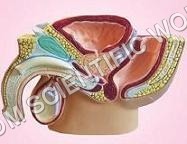

Price:
- 50
- 100
- 200
- 250
- 500
- 1000+

More Products in Human Anatomy Models Category
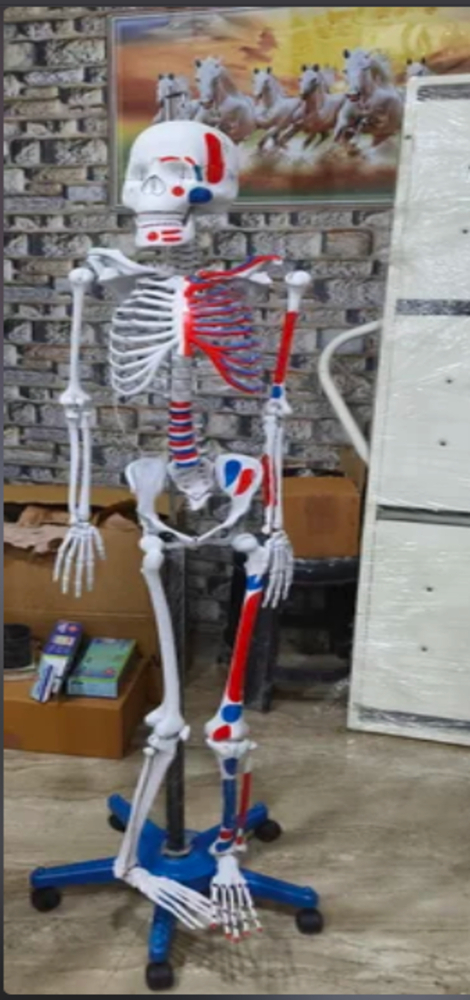
Human Skeleton
Price 1650.0 INR / Piece
Minimum Order Quantity : 1 Piece
Usage : Medical Education, School and College Demonstration, Physiotherapy Training
Type : Educational Skeleton Model
Feature : Movable Joints, Removable Limbs, Articulated, Washable Surface
Core Components : Full Human Skeleton with Stand and Removable Limbs
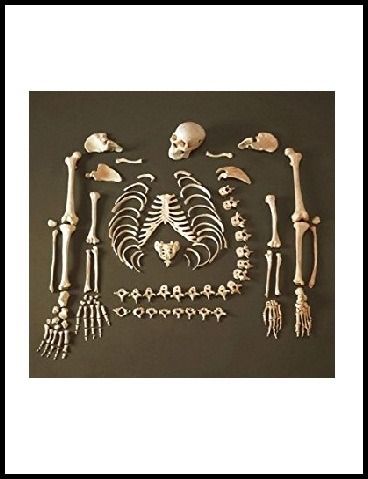
Disarticulated Human Skeleton (bilateral)
Price 124 INR / Unit
Minimum Order Quantity : 1 Unit
Usage : Educational, medical teaching, anatomy study
Type : Disarticulated Human Skeleton (Bilateral)
Feature : Handpainted details, realistic structure, bilateral representation
Core Components : Individual bones, ligaments
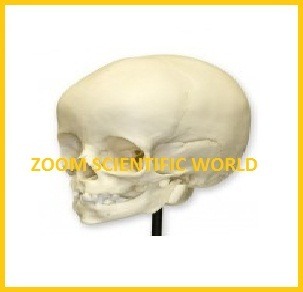
Foetal Child Skull (Infant Skull)
Price 104 INR / Piece
Minimum Order Quantity : 1 Piece
Usage : Medical Education, Anatomy Study
Type : Anatomical Model
Feature : Life Size, Accurate Anatomical Details
Core Components : Cranial and Facial Bones

Muscle Models
Price 124 INR / Piece
Minimum Order Quantity : 1 , , Piece
Feature : Realistic Detailing, Hand Painted, Removable Parts
Core Components : Muscle Model, Stand/Base

GST : 06ALAPA6623N1Z8

- 4537/1 A, Bldg. 13, Deepak Market, Ist Ambala - 133001, Haryana, India
- Phone : 08045478393
- Export Import Code (IEC code) - 3312001811
SSI No. - 060021100476

- Mr Sahil Aggarwal (GENERAL MANAGER)
- Mobile : 08045478393

|



Developed and Managed by Infocom Network Private Limited.
