




 Send Inquiry
Hot Plates
Price 109 INR/ Unit
MOQ : 1 Unit
Hot Plates Specification
- Material
- Mild Steel
- Voltage
- 110-220 Volt (v)
- Usage
- Laboratory
- Color
- Black And White
- Product Type
- Hot Plates
- Surface Type
- Smooth Top
- Max Power Consumption
- up to 2000W
- Heat Control
- Stepless Regulator
- Safety Feature
- Thermal Fuse Protection
Hot Plates Trade Information
- Minimum Order Quantity
- 1 Unit
- Payment Terms
- Cash in Advance (CID), Cash Advance (CA)
- Supply Ability
- 1000 Units Per Week
- Delivery Time
- 1 Week
- Sample Available
- Yes
- Sample Policy
- Sample costs shipping and taxes has to be paid by the buyer
- Main Export Market(s)
- Middle East, Central America, South America, Western Europe, Asia, Eastern Europe, North America, Australia, Africa
- Main Domestic Market
- All India
Hot Plates About
Hot Plates:- Laboratory hot plates are available in round and rectangular shapes.Body fabricated out of thick mild steel sheet duly finished in stoving enamel paint.The hot plate made of cast iron,nicely & precisely machined & smooth duly finished in heat resistant black paint is firmly mounted on the body.Heavy duty elements are securely layed under the plate to operate on 220V AC 50 Hz single phase.Temp. is controlled by a three - heavy rotary switch along with an indicator lamps for the mains and cord plug. (A) HOT PLATE:(ROUND)Single Specifications as above with 20cm. (8")dia. moulded top. (B) HOT PLATE:(ROUND)Double As above but with two plates of 20 cm. (8")dia. having independent piolet lamps & switches. (C) HOT PLATE(Rectangular) Specifications as above but plate is rectangular shape. Following standards sizes available: (i) 30*25cm.(12"*10") (ii) 40*25cm.(16"*10") (iii) 45*30cm.(18"*12") (iv) 60*45cm.(24"*18")Reliable Heating Performance
These hot plates deliver consistent heating results thanks to their sturdy mild steel construction and smooth top surface. With a power range of up to 2000W and compatibility with 110-220 volt systems, they are well-suited for a variety of laboratory heating tasks, ensuring accuracy and uniformity during experimentation.
User-Friendly Controls
Equipped with a stepless regulator, users have precise command over the heating levels. This enables exact temperature adjustments to match specific experimental requirements, enhancing workflow efficiency and reducing the risk of overheating.
Safety and Durability
Safety is prioritized with an integrated thermal fuse, which protects the unit from electrical faults or overheating. The mild steel body further adds to the hot plates durability, making it a dependable choice for daily laboratory operations and long-term use.
FAQs of Hot Plates:
Q: How do laboratory hot plates function for heating applications?
A: Laboratory hot plates use electrical energy to heat their top surface, providing a reliable and controlled heat source for various laboratory tasks. The smooth top and stepless regulator allow for precise temperature adjustment according to experimental needs.Q: What benefits do stepless regulators offer on hot plates?
A: Stepless regulators enable users to finely tune heating levels rather than being limited to preset settings, ensuring optimal temperature control and improved results for delicate procedures.Q: When should thermal fuse protection be considered essential in hot plate usage?
A: Thermal fuse protection is crucial whenever overheating could pose a risk to users or equipment. It automatically disconnects power if unsafe temperatures are detected, preventing potential hazards or damage.Q: Where are these hot plates typically used?
A: These hot plates are primarily designed for laboratory environments, including academic, research, and quality control settings in industries where precise and reliable heating is required.Q: What is the process for adjusting the heat on these hot plates?
A: To adjust the heat, users rotate the stepless regulator knob, increasing or decreasing the power output to the hot plates top, thereby achieving the desired temperature during operation.Q: What is the maximum power consumption of these hot plates, and how does it impact laboratory processes?
A: With a maximum power consumption of up to 2000W, these hot plates heat quickly and efficiently, supporting a range of laboratory applications without unnecessary power wastage or delays.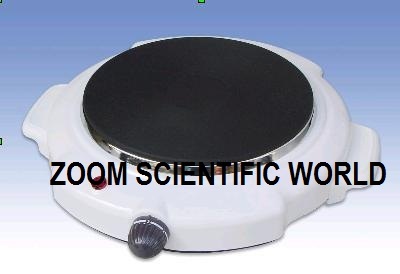
Tell us about your requirement

Price:
Quantity
Select Unit
- 50
- 100
- 200
- 250
- 500
- 1000+
Additional detail
Mobile number
Email

More Products in Scientific Product Category
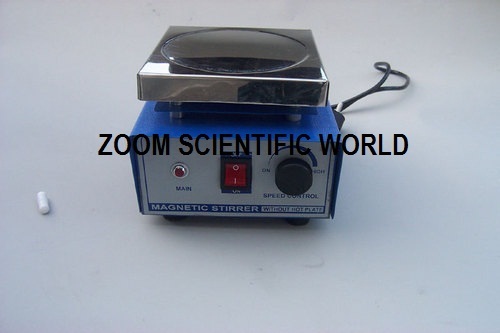
Magnetic Stirrer Without Hot plate
Price 123 INR / Unit
Minimum Order Quantity : 1 Unit
Color : Blue And Silver
Product Type : Magnetic Stirrer
Student Polarimeter
Price 143 INR / Unit
Minimum Order Quantity : 1 Unit
Color : Black And White
Product Type : Polarimeter
Material : Stainless Steel
Usage : Industrial
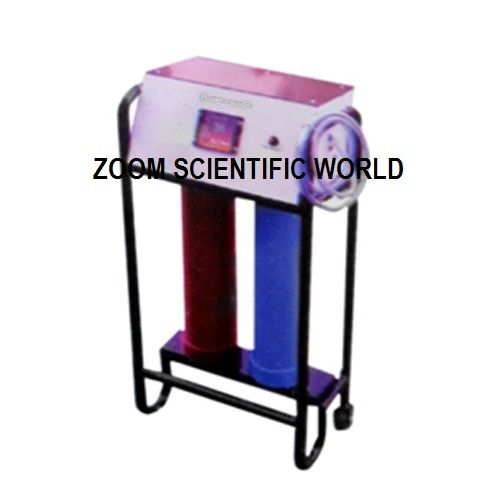
Water Deionzation Apparatus
Price 127 INR / Unit
Minimum Order Quantity : 1 Unit
Color : Blue And Red And White And Black
Product Type : Deionzation Apparatus
Material : Mild Steel
Usage : Laboratory, Industrial
Basal Metabolism Apparatus
Price 142 INR / Unit
Minimum Order Quantity : 1 Unit
Color : Silver And Red
Product Type : Metabolism Apparatus
Material : Aluminium Alloy
Usage : Medical

ZOOM SCIENTIFIC WORLD
GST : 06ALAPA6623N1Z8
GST : 06ALAPA6623N1Z8
Contact Details

- 4537/1 A, Bldg. 13, Deepak Market, Ist Ambala - 133001, Haryana, India
- Phone : 08045478393
- Export Import Code (IEC code) - 3312001811
SSI No. - 060021100476

- Mr Sahil Aggarwal (GENERAL MANAGER)
- Mobile : 08045478393

|



ZOOM SCIENTIFIC WORLD
All Rights Reserved.(Terms of Use)
Developed and Managed by Infocom Network Private Limited.
Developed and Managed by Infocom Network Private Limited.
