




 Send Inquiry
Rotary Vacuum Film Evaporator
Price 124 INR/ Unit
MOQ : 1 Unit
Rotary Vacuum Film Evaporator Specification
- Material
- Stainless Steel
- Voltage
- 110-240 Volt (v)
- Color
- White And Sky Blue And Black
- Product Type
- Film Evaporator
- Temperature Range
- 180 Celsius (oC)
- Connection Type
- Standard Quick Couplings
- Vacuum Range
- Up to 5 mbar
- Heating Bath Capacity
- 5 to 25 Liters
- Glassware Material
- Borosilicate Glass 3.3
- Chassis Finish
- Powder Coated
- Safety Feature
- Overheat Protection, Dry Run Protection
Rotary Vacuum Film Evaporator Trade Information
- Minimum Order Quantity
- 1 Unit
- Payment Terms
- Cash in Advance (CID), Cash Advance (CA)
- Supply Ability
- 1000 Units Per Week
- Delivery Time
- 1 Week
- Sample Available
- Yes
- Sample Policy
- Sample costs shipping and taxes has to be paid by the buyer
- Main Export Market(s)
- Australia, Middle East, Central America, South America, Western Europe, Asia, Eastern Europe, North America, Africa
- Main Domestic Market
- All India
Rotary Vacuum Film Evaporator About
Rotary Vacuum Film Evaporator Buch Type:- This model of evaporater is supplied complete with A.C. non-sparking geared drive unit,support stand fitted with Jack arrangement of stainless steel rod for positioning glass assembely,variable speed regulator,thermostatically controlled stainless steel water bath fitted on a Jack,double colled glass condenser with three opening for vacuum and cooling,pear shape evaporating flask capacity 800ml. receiver flask capacity one lit. with ball joint,feeding tube and vapour path tube,a complete working unit.All parts are powder coated with apoxy/polyster Hybrid,textured,siemens,grey finish.Reliable Construction for Laboratory Demands
Built from stainless steel and tough Borosilicate Glass 3.3, the Rotary Vacuum Film Evaporator withstands continuous laboratory use and resists chemical corrosion. This robust construction not only ensures longevity but also maintains sample purity during evaporation processes.
Precise Evaporation and Safer Operation
With a temperature range up to 180C and a vacuum capability reaching 5 mbar, this evaporator provides accurate control over solvent removal. Integrated overheat and dry run safety features minimize the risk of equipment damage and guarantee safe, consistent operation.
Versatile Applications and User Convenience
The adjustable heating bath (5 to 25 L capacity) accommodates diverse sample volumes, while standard quick couplings enable effortless assembly and cleaning. This makes the system suitable for various industries including pharmaceuticals, research, and chemical manufacturing.
FAQs of Rotary Vacuum Film Evaporator:
Q: How does a Rotary Vacuum Film Evaporator function?
A: A Rotary Vacuum Film Evaporator works by rotating a flask containing the liquid sample under reduced pressure, which lowers the boiling point of the solvent. The sample is gently heated in a controlled bath, and the solvent is evaporated and collected, allowing for efficient and safe concentration or purification of substances.Q: What safety measures are integrated into this evaporator?
A: The evaporator is equipped with overheat protection and dry run protection, which prevent damage to the system and ensure user safety during operation. These features automatically halt operation if unsafe conditions are detected.Q: When should I use a vacuum film evaporator in a laboratory?
A: Use a vacuum film evaporator when you need to remove solvents from sensitive samples at lower temperatures, such as during purification or concentration steps in pharmaceutical, research, or chemical laboratories.Q: Where can the Rotary Vacuum Film Evaporator be applied?
A: This evaporator is commonly used in pharmaceutical manufacturing, research institutions, and chemical laboratories where precise and gentle evaporation of solvents is essential.Q: What is the process for setting up the evaporator?
A: To set up the device, connect the glassware using the standard quick couplings, fill the heating bath (525 L) with the appropriate fluid, and establish the desired temperature and vacuum (up to 5 mbar). Ensure all safety features are functional before operation.Q: What are the main benefits of using this evaporator?
A: The key benefits include efficient and uniform solvent evaporation, reduced risk to temperature-sensitive compounds, robust chemical resistance, convenient cleaning and assembly, and integrated operational safety features.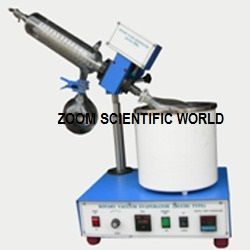
Tell us about your requirement

Price:
Quantity
Select Unit
- 50
- 100
- 200
- 250
- 500
- 1000+
Additional detail
Mobile number
Email

More Products in Scientific Product Category
Keratometer
Price 130 INR / Piece
Minimum Order Quantity : 1 Unit
Color : Black
Product Type : Keratometer
Voltage : 100240 Volt (v)
Anaerobic Culture Jar
Price 120 INR / Unit
Minimum Order Quantity : 1 Unit
Color : Transparent
Product Type : Culture Jar
Usage : Laboratory
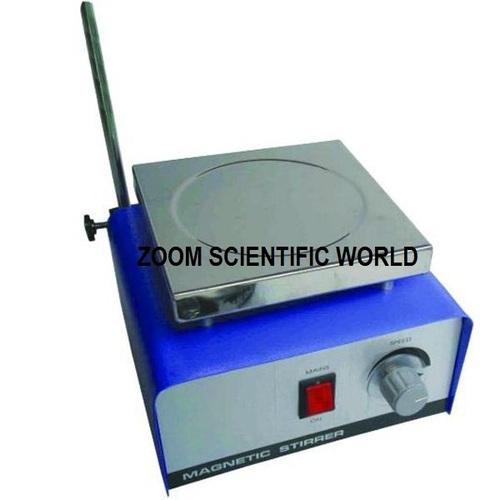
Magnetic Stirrer
Price 124 INR / Unit
Minimum Order Quantity : 1 , , Unit
Color : Silver And Purpal
Product Type : Magnetic Stirrer
Voltage : 110240 Volt (v)
Usage : Laboratoy

Binocular Research Microscope
Price 124 INR / Unit
Minimum Order Quantity : 1 Unit
Color : Black And White
Product Type : Microscope
Voltage : 110220 Volt (v)
Usage : Laboratory

ZOOM SCIENTIFIC WORLD
GST : 06ALAPA6623N1Z8
GST : 06ALAPA6623N1Z8
Contact Details

- 4537/1 A, Bldg. 13, Deepak Market, Ist Ambala - 133001, Haryana, India
- Phone : 08045478393
- Export Import Code (IEC code) - 3312001811
SSI No. - 060021100476

- Mr Sahil Aggarwal (GENERAL MANAGER)
- Mobile : 08045478393

|



ZOOM SCIENTIFIC WORLD
All Rights Reserved.(Terms of Use)
Developed and Managed by Infocom Network Private Limited.
Developed and Managed by Infocom Network Private Limited.
